By Aubrey Dean, Director of Youth Athletics, SOVRN Performance Lab
When parents think about helping their kids become better athletes, strength and speed are often at the top of the list.
But for younger athletes, getting stronger doesn't necessarily mean putting more weight on a barbell. Especially with our middle school athletes, one of our biggest priorities is helping them learn how to control their bodies.
That means developing the coordination to jump and land, accelerate, slow down, and change direction efficiently. These fundamental skills create a foundation for strength, speed, and long-term athletic development.
Learning to Move Before Adding Weight
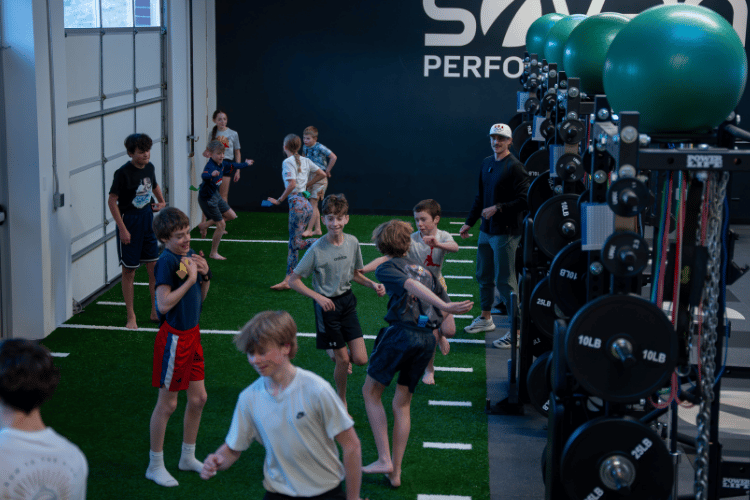
Watch a group of younger athletes perform a jumping drill, and you'll probably notice that no two kids move exactly alike. Some struggle to coordinate their arms and legs, while others have difficulty controlling their landing or maintaining balance.
That's normal. Growing athletes are still developing body awareness and learning how to coordinate their movements.
One of the most noticeable improvements I see in middle school athletes is their ability to control their bodies. Within just a few weeks of consistent training, kids who initially struggle with basic movements often become noticeably more coordinated and confident.
Before increasing the difficulty of an exercise or adding more weight, we want athletes to demonstrate control over fundamental movements, including:
- Jumping and landing with proper technique and stability.
- Accelerating and decelerating while maintaining balance and control.
- Changing direction efficiently and with good body positioning.
These are skills athletes rely on constantly in sports, and developing them early creates a foundation for more advanced training.
Why Speed and Force Development Matter
Strength is important, but so is how quickly an athlete can use it. This is where rate of force development comes into play. In simple terms, it's how quickly the body can generate force.
Think about a soccer player who needs to stop, change direction, and accelerate toward the ball. Or a basketball player reacting to a defender and driving toward the basket. These movements require athletes to generate force quickly while maintaining control of their bodies.
For younger athletes, developing these abilities can be more immediately relevant to their sport than focusing on how much weight they can back squat.
Sprinting is one of the most effective ways to develop these abilities in young athletes. It challenges coordination, force production, and the nervous system's ability to organize movement at high speeds. It's also a fundamental skill that carries over to a wide range of sports.
At SOVRN, we've seen many young athletes improve their sprint times within just a few weeks of consistent training. Seeing that measurable progress helps kids recognize the value of their effort.
When Should Young Athletes Start Lifting Heavier?
Strength training can be beneficial for young athletes when it's appropriately designed and supervised. But the emphasis should change depending on an athlete's age, experience, and development.
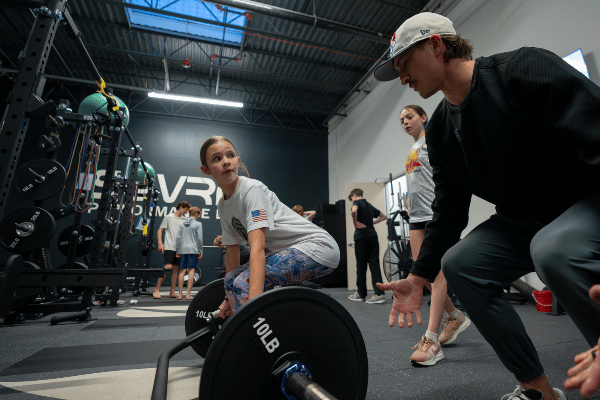
For many middle school athletes, the priority is learning proper technique and building movement competency. That might mean performing squats, hinges, lunges, and other foundational exercises with lighter loads while developing control and confidence.
As athletes demonstrate good technique and become more experienced, resistance can be increased gradually. By high school, many athletes are ready to place more emphasis on developing maximal strength and moving heavier loads, while continuing to prioritize proper movement mechanics.
It’s less about avoiding strength training when kids are young and more about building the skills to handle heavier loads safely and effectively.
Building a Foundation for Long-Term Development
There's nothing wrong with wanting to be faster, stronger, or more explosive. But youth athletic development shouldn't be a race to see who can lift the most weight.
At SOVRN, we focus on helping young athletes develop the movement skills, strength, and confidence they need to continue progressing as they grow.